 Indra G. Prasetya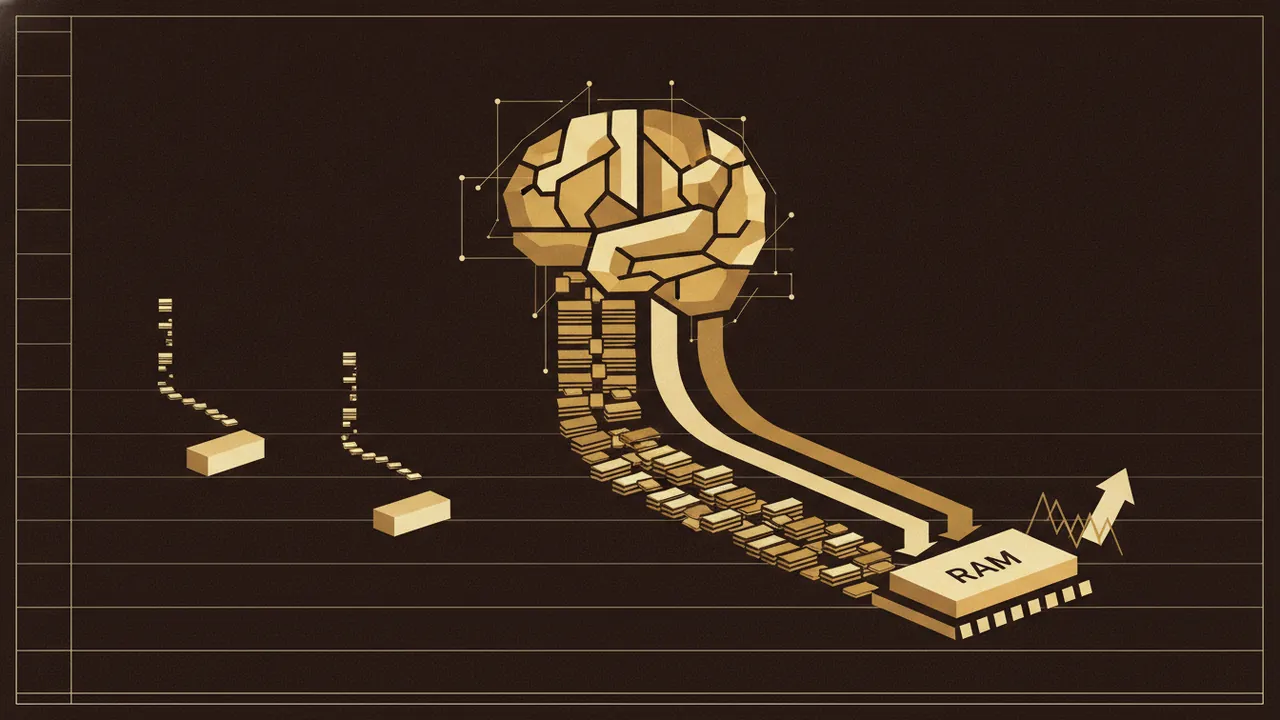
Price a Kubernetes node pool in January, re-quote it in June, and the memory line has roughly tripled. Nobody on the vendor side will give you a straight reason. The industry has a name for it, used without much irony: the RAMpocalypse. The real story underneath is duller and worse. The world's DRAM fabs are being structurally re-pointed at AI, and that reallocation is now landing in everyone's capacity plan, not just the hyperscalers who started it.
TL;DR: AI takes about 20% of DRAM wafer starts in 2026, but HBM burns roughly three times the wafer capacity per gigabyte, so the commodity bit pool drains much faster than that headline implies. Conventional DRAM contract prices were forecast up 58% to 63% quarter-on-quarter in Q2 2026, with NAND up 70% to 75%. Plan around it as a condition through at least 2027: re-baseline every capacity model, reclaim overprovisioned memory, and lock forward terms now.
The 20% number that lies to you
The figure everyone quotes is the reassuring one. TrendForce's December 2025 forecast that AI will consume 20% of global DRAM wafer capacity in 2026 puts HBM and GDDR7 at a fifth of the fabs. That sounds survivable.
It is not, and the reason is the whole article: HBM does not turn wafers into usable bits at anything close to the rate commodity memory does.
Here is the part that bites. Per Tom's Hardware's breakdown of the supply-chain analysis behind the shortage, one gigabyte of HBM consumes roughly three times the wafer capacity of one gigabyte of DDR5. That is yield loss from die stacking plus the extra process steps. So when a fab shifts a wafer from DDR5 to HBM, it is not a one-for-one trade. It is closer to three bits of commodity DDR5 and LPDDR5 vanishing for every one bit of HBM that ships.
The "20% of capacity" headline is technically about wafer starts. The damage to the commodity bit pool, the actual RAM going into your servers, laptops, and phones, is disproportionately larger than 20%. That gap is why "AI is only a fifth of the fab" and "your server memory contract jumped 60% in a quarter" are both true in the same breath.
This is now an infrastructure-budget problem, not a PC story
For a while you could file this under consumer-PC inflation and ignore it, but that window closed.
TrendForce's March 31, 2026 forecast put conventional DRAM contract prices up 58% to 63% quarter-on-quarter in Q2 2026. NAND Flash contract prices in the same window: up 70% to 75% quarter-on-quarter. Contract prices, not spot. That distinction matters more than it sounds. Spot is the noisy number traders chase. Contract is what your procurement team and your cloud provider actually sign, which means it flows straight into instance pricing and hardware quotes a quarter or two later.
So your storage budget moves with the same tide. NAND up 70-plus percent QoQ means SSDs and storage tiers inflate alongside RAM. If you patch your memory forecast and leave the storage forecast at last year's numbers, you have only fixed half the hole. It also lands on top of the power and serving-stack costs I walked through in AI compute costs in 2026, which is the other half of the same bill.
Why suppliers want it this way
The most uncomfortable detail is that none of this is an accident, and accidents are the only kind of shortage that resolves on its own.
TrendForce notes that suppliers are prioritizing server DRAM for its superior profitability and signing long-term agreements (LTAs) with cloud service providers, who will pay more to lock in supply for the AI server build-outs that eventually reach your cluster as DRA-scheduled GPU nodes. From the fab's side, Samsung, SK hynix, and Micron are looking at a choice between low-margin commodity DDR5 and high-margin HBM plus guaranteed multi-quarter CSP contracts; they picked the money.
TrendForce's December 2025 analysis framed it plainly: DDR5 profitability is intensifying the capacity crowding. The squeeze is a pricing strategy. Strategies do not reverse in ninety days because your refresh budget is uncomfortable.
And HBM's slice keeps growing. Figures attributed to TrendForce across the coverage put HBM at roughly 23% of total DRAM wafer output in 2026, up from about 19% in 2025. Every point HBM gains is commodity DDR5 leaving the market. The trend line points the wrong way for anyone buying ordinary RAM.
The fab can't just pivot back
There is a hope buried in a lot of procurement conversations: prices spike, suppliers chase the spike, capacity floods back, prices crater. It is the classic memory cycle, and it has happened before.
It is shakier this time because the lines are not interchangeable. HBM needs its own production tools, masks, and advanced packaging. That equipment sits where DDR5 or LPDDR5 lines would otherwise run. A fab cannot flip a tool back to commodity output over a weekend, and the capital is already committed to the high-margin product. This is why analysts keep using the word structural rather than calling it a temporary allocation choice. The bottleneck is built into the equipment plan.
The duration estimates match that. SK hynix's CEO has reportedly estimated the shortage running until 2030. Even the optimistic industry reads point to late 2027 before supply meaningfully eases. Either way you are planning around a condition, not waiting out a blip.
It compounds on an already-high base
2026's jump is not starting from a calm baseline. The compiled record of the ongoing memory shortage has DRAM rising roughly 172% across 2025, before these 2026 contract increases even landed. Memory's share of a PC bill of materials has reportedly climbed from the mid-teens toward roughly a third over the same stretch.
So the 58% to 63% QoQ figure is a percentage increase on top of a number that already doubled-and-then-some last year. For server fleets, where you are buying memory by the terabyte, that compounding is the difference between a noticeable line item and a board-level conversation.
The counterargument, and why I don't buy it this time
The honest objection: memory is famously cyclical, and every shortage in history has ended in a glut. People who lived through the 2018 and 2023 down-cycles will tell you cheap RAM always comes back. They are right about the past.
But every prior cycle was driven by demand swings on an interchangeable commodity product. When demand fell, the same lines that made the expensive RAM made the cheap RAM, and prices collapsed. This cycle is driven by suppliers deliberately reallocating fab capacity toward a higher-margin, non-interchangeable product under multi-year contracts. The thing that broke the old gluts, instant fungibility of supply, is exactly what HBM lacks. Until that allocation reverses, and the people signing the LTAs are betting years of capacity that it will not, the cheap-RAM assumption is the riskiest line in your capacity plan.
What to do before your next refresh quote
Concrete moves, each tied to a number above. Do these this quarter, not next.
- Re-baseline any capacity model older than two quarters. If your cost-per-node, cost-per-pod, or cost-per-GB-cached math predates the Q2 2026 contract jump, it is understating memory by 50% or more. Re-quote with current contract pricing before you commit a single refresh PO or new cluster.
- Audit Kubernetes memory requests against actual usage. Overprovisioned requests and idle headroom were free insurance when DRAM was cheap. At 58% to 63% QoQ, that slack is a measurable line item. Pull requests-vs-usage from your metrics, find pods sitting at 30% of their request, and reclaim the gap. This is the fastest dollar you will save with zero hardware spend.
- Lock forward terms now if you run on-prem or colo. CSPs are signing LTAs precisely because spot exposure is brutal. Call your memory and SSD vendors about forward pricing or a fixed-term agreement before the next quarterly reset. Waiting one more quarter is a bet against a documented 58-to-75% trend.
- Budget NAND in the same pass. Storage is up 70% to 75% QoQ per TrendForce, so SSD tiers move with DRAM. Update the storage forecast in the same spreadsheet, same meeting. Do not ship a RAM-only correction.
- Re-examine memory-as-a-crutch architecture. In-memory caches, oversized JVM heaps, and "just add RAM" scaling all got a recurring quarterly tax. Where a design leans on cheap memory to dodge engineering work, that trade just inverted. Right-size the heap properly instead, the way the Node 24 mark-compact failures force you to.
- Plan multi-year, not next-quarter. With LTAs locking allocation and HBM at ~23% of wafer output and climbing, treat this as structural through at least 2027, possibly to 2030 on SK hynix's own estimate. Revisit pricing every quarter and stop modeling a return to 2024 memory costs.
If the re-baselining and the requests-vs-usage audit keep sliding down your quarter, get in touch and I will run them against your fleet.
The uncomfortable summary for anyone who signs infrastructure budgets: memory stopped being a rounding error and became a strategic input, priced by people whose interests run directly against yours, so plan accordingly.
FAQ
Why are DDR5 prices rising if AI only takes 20% of DRAM capacity? Because wafer share is not bit share. HBM burns roughly three times the wafer capacity per gigabyte, so a fifth of wafer starts removes a much larger fraction of the commodity bits that end up as DDR5 and LPDDR5.
When will the 2026 RAM shortage end? SK hynix's CEO has reportedly put it at 2030. The more optimistic industry reads point to late 2027. Neither is a horizon you can wait out, so budget for the condition rather than the recovery.
Does the memory shortage push SSD and NAND prices up too? Yes. TrendForce forecast NAND Flash contract prices up 70% to 75% quarter-on-quarter in Q2 2026, slightly ahead of DRAM. Correct the storage forecast in the same pass as the memory one.
Why can't DRAM makers switch HBM lines back to DDR5 when prices spike? HBM needs its own tools, masks, and advanced packaging, and that equipment occupies the floor space commodity lines would use. The capital is committed and the output is contracted, so there is no weekend pivot.
What is the fastest way to cut memory cost without buying hardware? Reclaim overprovisioned Kubernetes requests. Pull requests against actual usage, find the pods sitting near 30% of their request, and resize. It costs engineering time instead of capex and it lands this quarter.
Comments
Be the first to comment.