 Indra G. Prasetya
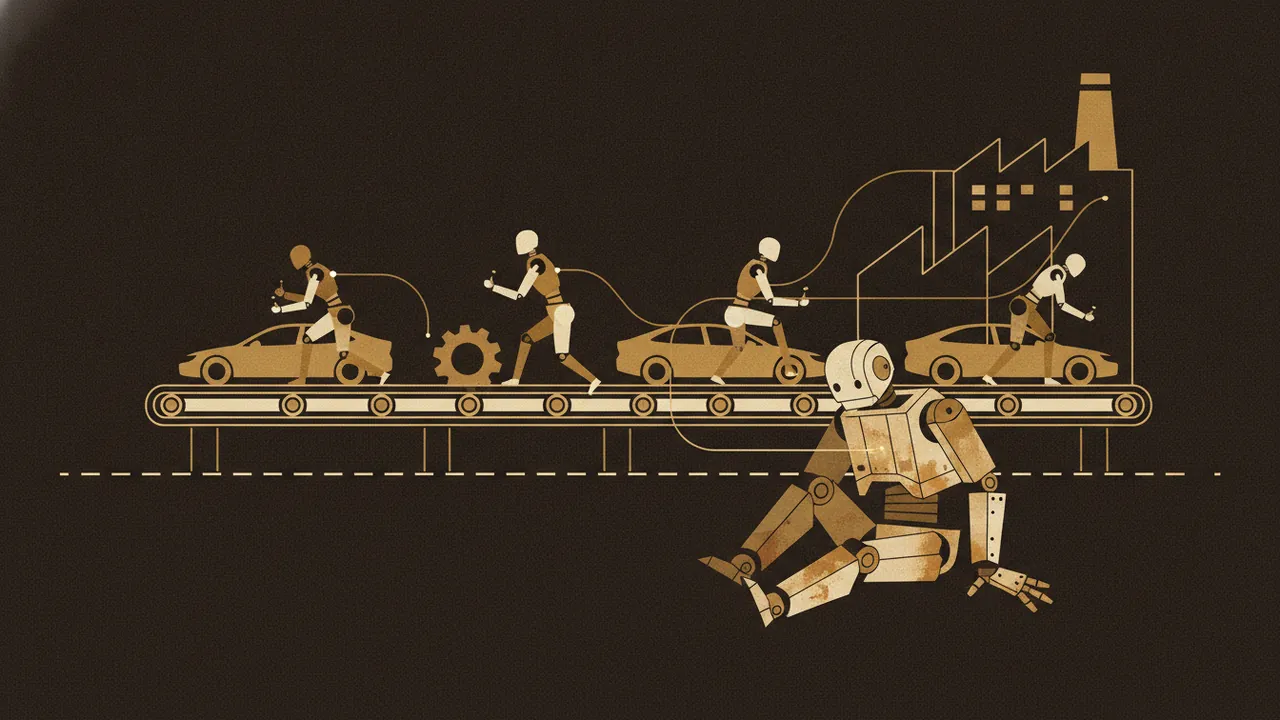
Figure's write-up of the BMW run says its F.02 robot "contributed to the production of 30,000+ X3 vehicles" at BMW's plant in Spartanburg, South Carolina. Loaded 90,000-plus sheet metal parts. Logged 1,250-plus hours on a live assembly line. After ten years of stage demos and treadmill walks, that is a real number from a real factory, and it deserves to be read carefully. Most coverage stopped short of the sentence that matters: that robot has been retired.
TL;DR: Humanoids cleared the capability bar in 2026 and have not cleared the availability bar. F.02 placed 90,000-plus parts over 1,250-plus hours at Spartanburg and was then pulled off the line when Figure 03 launched, and Tesla's 1,000-plus Optimus units run on a floor Tesla owns and self-certifies. Budget a humanoid as a pilot line item until a vendor contracts to availability above 99.9% with on-site support priced into the quote.
The headline numbers are real
Two of the loudest names in the field finally stopped quoting choreography and started quoting line output. Figure's Spartanburg run hit greater than 99% placement success per shift on a 37-second load cycle, ten-hour shifts, five days a week, all on the chassis assembly line. Tesla, separately, says more than 1,000 Optimus units were already working its Fremont floor in January 2026, doing battery assembly, pack loading, cable routing and parts handling, with a dedicated line targeting 100,000 to 300,000 units this year per The Robot Report.
I want to be clear that this is genuinely new. A fixed pick-and-place task, run for months on a production line at automotive takt, with a placement success number you can audit, is not a demo. For the first time, the category has produced metrics an operations lead can actually argue about. Take the capability seriously.
The trouble starts the moment you treat the capability number as an availability number.
The footnote that inverts the headline
Figure puts the most important sentence of the announcement near the bottom. F.02 "return[ed] to HQ from BMW as part of our fleet-wide retirement" once Figure 03 launched. So the 30,000-car figure is the lifetime output of a pilot that has ended, not the running rate of a station that still exists. As of now there are no Figure robots on the Spartanburg line.
BMW's own June 2026 press release reads the same way once you stop skimming. The company frames its next move as a new pilot at Plant Leipzig in Germany starting summer 2026, with a test deployment from April to prepare, and it is standing up a "Center of Competence for Physical AI in Production." Read that as a company still de-risking. You do not build a center of competence for something you have already committed a line to.
Name the gap, because it organizes everything else. There are two clocks running on this story. One is the demo clock, which measures what a robot has ever done: cars built, parts placed, hours logged. The other is the line clock, which measures what a robot is doing right now and will keep doing next quarter: availability, mean time between failures, vendor staffing on site. The headlines all run on the demo clock. Your maintenance budget runs on the line clock. They are showing wildly different times.
Why the reliability gap is the whole story
A welding cell built around a KUKA or Fanuc arm is engineered for 99.99%-plus availability and runs for years between major failures. Lines get designed around that bar, because anything below it stops the line, and a stopped line is the most expensive thing in the building.
Now put a 99% per-shift success rate next to that. It sounds adjacent. It is not even close. The independent 2026 assessment from EVS Insight argues that mean time between failures for precision manipulation on today's humanoids is orders of magnitude lower than a fixed industrial arm, that most deployments still need on-site vendor engineers, custom environment prep, and real integration work to hit their numbers. A robot that succeeds 99 times out of 100 and needs a human nearby for the hundredth is a fantastic pilot. It is also a line that halts more than once per shift.
Then there is the battery wall, which nobody puts in the headline. Most commercial humanoids run two to five hours on a charge. That means swap stations or charging chairs designed into the cell, and a duty cycle that a bolted-down arm simply does not have. None of this appears in a 30,000-car number. All of it appears in your TCO.
The economics break even later than the pitch implies
Tesla is breaking ground on a second-generation line at Giga Texas aimed at a long-term 10 million units per year, quoting a $20,000 to $30,000 unit price. When a number like that lands in a procurement deck, the instinct is to compare it to a year of loaded human labor and call it a deal.
Resist that math for a second. EVS Insight pegs realistic break-even at unit cost below $30,000 and operational lifetime above 20,000 hours, and expects that combination in the 2028 to 2031 window, not today. In low-labor-cost regions, current humanoid total cost of ownership still exceeds a loaded human operator.
Spartanburg already answered "can a humanoid do the task." The unanswered questions are the expensive ones: at what sustained line rate, at what quarter-over-quarter availability, with how many vendor engineers in the building, and for how many hours before the joints need service. Nobody front-loads that last number, and it decides whether $25,000 is cheap or a down payment on a maintenance contract. Compute budgets hide the same kind of tail: the sticker is the small part, and the power and serving stack behind it carries the real bill.
The honest counterargument
The strongest objection to all of this: Tesla isn't running a months-long pilot, it is running more than 1,000 units in continuous internal production, which looks a lot like a standing line. Fair. Nothing else in the field is more bullish, and I am not waving it away.
But notice who the customer is. Those Optimus units are Tesla deploying to Tesla, on a line Tesla controls, reporting numbers Tesla self-certifies. Call it a vendor eating its own dog food, which is useful and real, and also exactly the arrangement where the awkward metrics (unplanned downtime, engineer-hours per shift, units pulled for service) never have to leave the building. An external customer paying for guaranteed output is a different and harder test. Until a humanoid runs someone else's line, past one hardware generation, without the vendor's engineers on site, "1,000 units" is a strong signal and not yet proof.
How to buy one in 2026 without getting burned
If a vendor walks in this year quoting cars-built or parts-placed, run the deal through these gates in order. Each one ties to a specific failure mode above.
- Re-ask every demo number as a line number. Cars built tells you nothing. Ask for sustained cycle time at your takt, availability over a full quarter, MTBF on the manipulator, and the count of vendor engineers on site to hit the quoted figures. If they can only give you lifetime totals like "30,000 cars," they are selling you the demo clock. Demo numbers mislead in software too, as the AI agent you deployed last quarter keeps proving.
- Treat "retired" as data, not trivia. F.02 got pulled after roughly eleven months for a hardware refresh. That tells you the upgrade cadence is fast and the install base is disposable, so budget these like GPU fleets you replace every generation, not like a ten-year fixed asset you depreciate slowly. Vendors retire a generation on their own schedule, as one model shutdown taught everyone who had built on it.
- Scope the task before you scope the robot. Spartanburg worked because the job was one bounded pick-and-place: insert sheet metal parts into a fixture. If your candidate task needs sub-millimeter repeatability, payloads over roughly 10 kg, or certified-hazardous operation, current humanoids are the wrong tool. Buy a fixed arm. Match the platform to a narrow, high-frequency, low-precision-tolerance step first.
- Set a numeric trigger, not a vibe. Pilot a humanoid only where 99% per-shift success is acceptable and a failure is recoverable without stopping the line. Commit a permanent station only when the vendor will contract to availability above 99.9% with on-site support priced into the quote. If unit cost is above $30,000 or expected service life is under 20,000 hours, it is R&D, budget it as R&D.
- Watch Leipzig and Fremont, ignore the next cars-built press release. The milestone that actually matters is the first external customer running humanoids on a line continuously, past one hardware generation, without the vendor staffing the floor. Until that lands, the category is proven capable and unproven durable. Plan accordingly.
FAQ
Are there Figure humanoids working at BMW Spartanburg right now? No. F.02 went back to HQ in Figure's fleet-wide retirement once Figure 03 launched, so the 30,000-car total belongs to a pilot that ended. BMW's next humanoid work is a fresh pilot at Plant Leipzig starting summer 2026.
Is 99% placement success good enough for a production line? For a pilot, yes. For a permanent station, no. A fixed arm is specified at 99.99%-plus availability, so 99% per shift on a 37-second cycle means repeated interventions inside every shift.
What does a factory humanoid cost in 2026? Tesla quotes $20,000 to $30,000 per Optimus at volume. EVS Insight puts break-even at under $30,000 plus more than 20,000 hours of service life, and expects that pairing in 2028 to 2031.
How long does a factory humanoid run on one charge? Two to five hours for most commercial units, so charging chairs or battery swaps have to go into the cell design, and the duty cycle never matches a bolted-down arm.
Which task should I pilot a humanoid on first? A bounded, high-frequency step where a failure is recoverable without stopping the line, like inserting parts into a fixture. Sub-millimeter repeatability or payloads over roughly 10 kg belong to a fixed arm.
If you would rather hand the evaluation to someone who has run these gates against a real line, tell me about the station you have in mind.
Comments
Be the first to comment.